Hashimoto’s High Bar heroics bring the Japanese men World title number eight
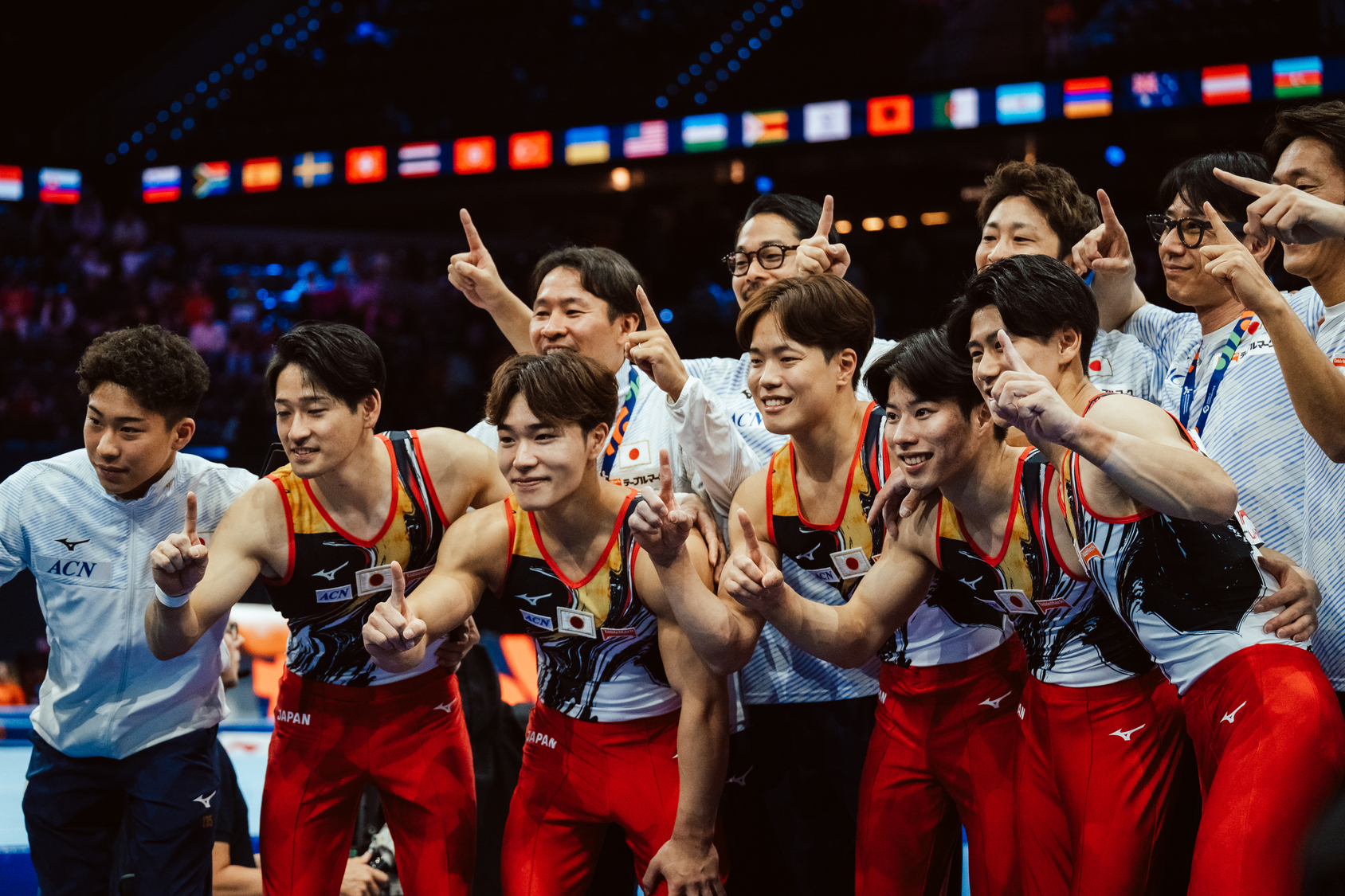
A topsy-turvy men’s team final ended with Japan retaining the World team title in Artistic Gymnastics, assuring the reigning Olympic champions will return a full team to the Games in Los Angeles.
Breathtaking High Bar routines by Maeda Fusuke and Hashimoto Daiki put Japan over the top in a World Championship final that was only decided in the final moments of the competition Tuesday evening in Rotterdam.
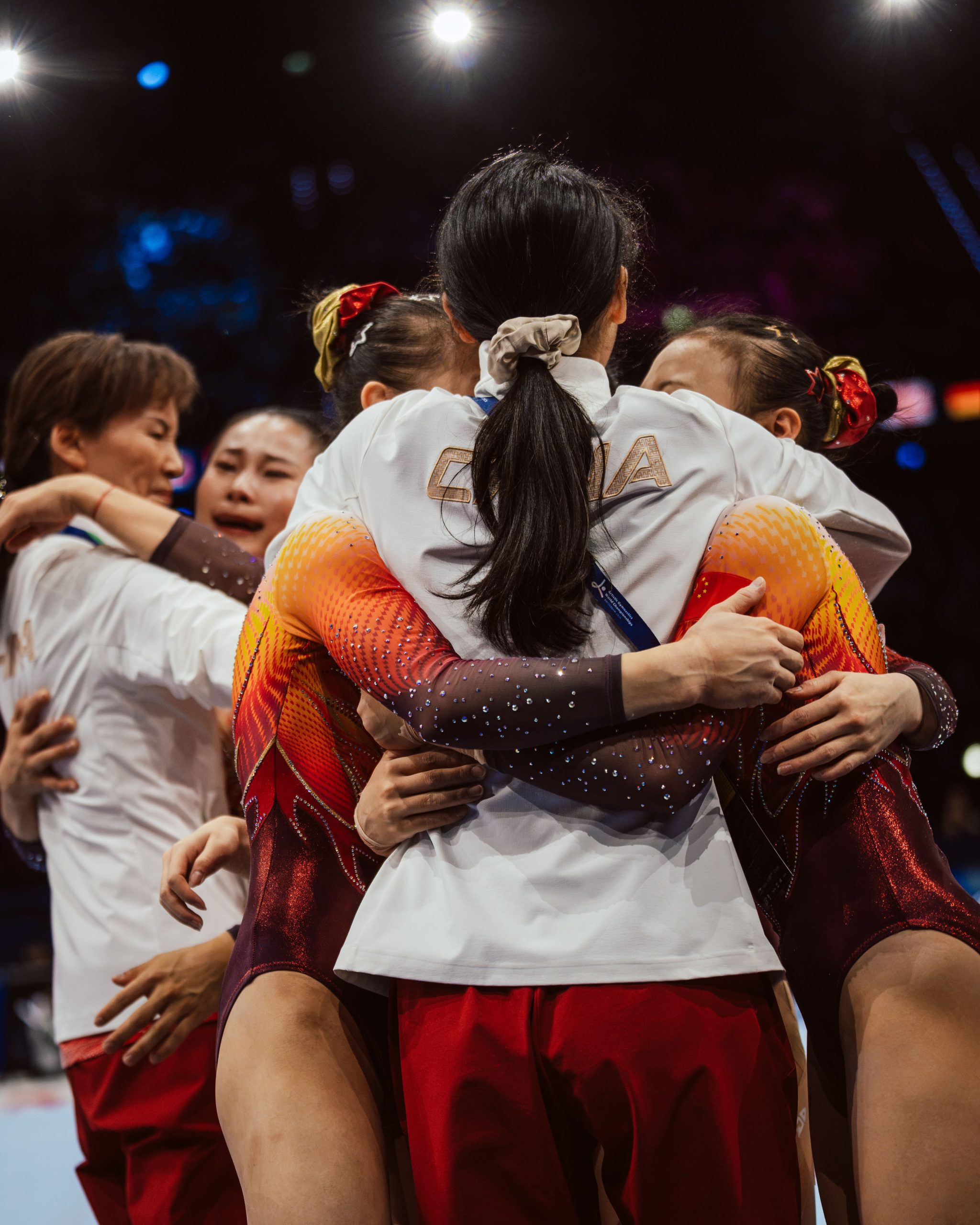
WG2 earned silver for one of the most consistent overall performances among the eight teams in the final, while the People’s Republic of China took bronze.
All three nations punched their tickets to the 2028 Olympics in the first of two Olympic team qualification events. Who gets the final nine team berths to Los Angeles will be decided at next year’s World Championships in China.
Japan entered the medal round confident after a smooth qualification that saw them eclipse Great Britain by three points. Much of that cushion stemmed from superior performances on Parallel Bars and High Bar, so when Olympic All-Around champion Oka Shinnosuke fell from the former and Kawakami Shohei dropped off the latter late in the unforgiving all-routines-count final, what had seemed like a sure thing was suddenly in doubt.
But Maeda and then Hashimoto rallied, delivering knockout performances on High Bar to score 14.333 and 14.866 points respectively, bringing Japan’s overall total to 251.928, almost 1.6 ahead of WG2 and just about three points ahead of the Chinese.
“It was a truly wonderful moment,” Hashimoto said. “However, today’s competition was extremely difficult. In the history of this sport, it’s been rare recently for a Japanese team to win consecutive titles. Our primary goal was to achieve back-to-back team victories, so I’m happy we managed that, and I’m glad to have left a mark on history.”
The world title is the eighth for the Japanese men, who won five in a row between 1962 and 1978 and also took golds in 2015 and 2023. With their second World title in three years and an Olympic gold medal from Paris sandwiched in between, the Japanese men seem in the midst of a new golden epoch.
Japan was able to absorb two falls and still win because other nations started having problems toward the end of the competition. Low difficulty on Still Rings and a fall from specialist Ilia Zaika put WG2 at a disadvantage early on, but excellent work on High Bar and a stellar Floor Exercise rotation anchored by rising star Arsenii Dukhno mitigated the early troubles, resulting in a better-than-expected silver medal.
“Olympic qualification was the main objective,” said Daniel Marinov, who spoke to reporters holding the small plaque with the LA 2028 logo that was bestowed on newly qualified teams. “I think we’ll keep this ticket in our training facility,” he added. “It will serve as motivation for us!”
China was brilliant on Still Rings and Parallel Bars, where Olympic champion Zou Jingyuan scored a competition-high 15.366. But falls elsewhere from newcomers Li Hongyan and Yang Haonan ultimately left a Chinese team that was missing star Zhang Boheng holding bronze.
“We certainly came here with the goal of winning the championship, but in the end, competitive sports can be cruel; there’s just no way around it,” commented Tian Hao. “While some may have performed well and others perhaps not as well, it doesn’t matter — we’ll just get back up wherever we’ve fallen.”
Great Britain finished a distant fourth after counting falls on Floor Exercise, Parallel Bars, and Horizontal Bar. Switzerland, the USA, the Netherlands, and first-time finalist Colombia rounded out the top eight.
Though their efforts didn’t result in a medal, the host nation was elated to take seventh in only their second World team final. The Dutch men previously finished eighth in 2018, making Tuesday “our best performance ever,” enthused Casimir Schmidt, who at 30 is the team’s elder statesman.
“I didn’t think we were going to experience this — me for sure not — in our careers,” he added, “so it’s incredible for us.”
Men’s competition continues Thursday at the World Championships with the All-Around final.
Hulst has a solid reputation in cyclo-cross and the province of Zeeland is known as a cyclocross-loving region. Regarding the course, the highly acclaimed Vestingcross served as the foundation for an even more impressive circuit for the World Championships. The Vestingcross has been a staple in the cycling world for nearly a decade and has been part of the World Cup circuit for the last five years.
During the World Championships, riders will traverse the fortress walls and cross waterways using pontoons. The technically challenging course features steep climbs and breathtaking descents. Additionally, a new area of terrain will be incorporated into the circuit.
New for this event is the impressive size of the grandstands along the course, allowing many spectators to opt for standing viewing. Additionally, there will be multiple fan zones where supporters can cheer on their favorite riders together.
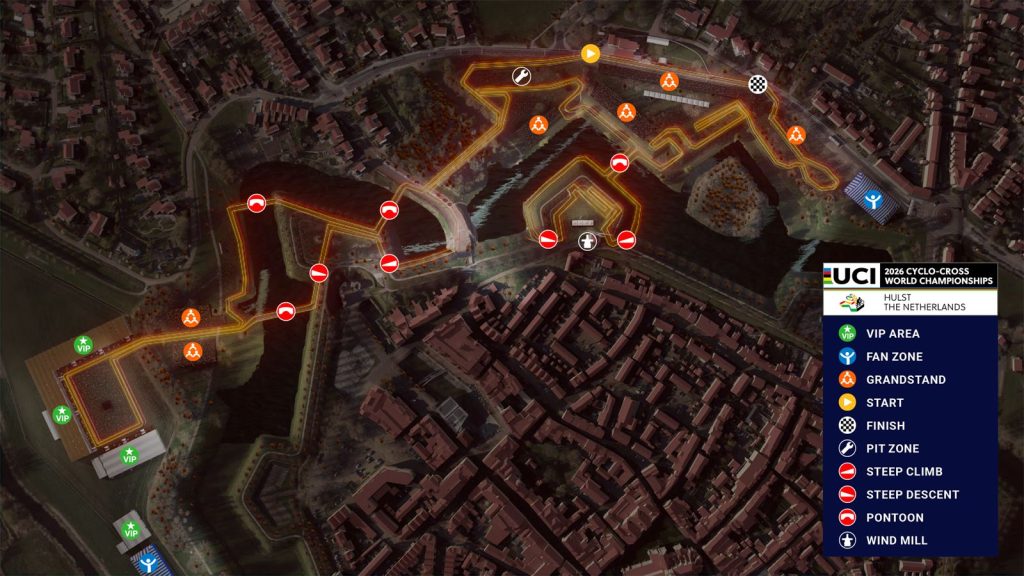
Course map of the 2026 UCI Cyclo-cross World Championship in Hulst
The local organizing committee will announce more plans later this year to make the 2026 UCI Cyclo-cross World Championships ‘an event like no other’. The side program already includes the Celebrity Cross, a celebrity race featuring well-known Flemish and Dutch personalities.
“These World Championships will go down in history as an unparalleled cycling festival for die-hard cyclo-cross fans, new supporters, families, business relations, and, last but not least, the people of Hulst and Zeeland”, according to the local organizers.
Tickets for the 2026 UCI Cyclo-cross World Championships are now available for purchase on the official website.
Course facts
- 3.3 kilometers
- 150 meters of height
- 5 pontoons
- 8 bridges
- 2 descents and climbing sections